Exploring a New Material – Silver Samples

June 25th, 2013

You know how I love glitter!

And last week, while strolling around the barrio Independencia in Santiago de Chile on a fabric shop crawl with Suzie and her friend Gladys, I was stopped in my tracks by this shiny silver fabric which seems to be mylar bonded to black ripstop nylon.  Now I’m not sure what anyone would do with it – make a stunning windproof jacket perhaps – the guy in the shop just sells the remnant rolls and doesn’t have any info beyond basic fibre composition.  If I lived in Santiago, I’d have bought the minimum cut, which was 2m in that shop, taken it home, played with it and gone back for more if I liked what it did.  Since I was leaving the next morning, I just bought the rest of the bolt, all 8m, as you can’t go wrong  at US$3/m, and brought it home.  I had to hand carry it, no room in my small bag – and it was heavy!  Of course, if there had been gold there too, I’d have bought a major amount of that as well !

This afternoon I played with this exciting fabric, and thought you’d be interested to see the results, all assembled here in this pic:

Silver-Samples


At the top LH corner is a piece which has had a pink strip inserted and sewn down with silver metallic machine stitching – it buckles quite a bit even on low iron. Beside that is a strip that has been bonded on with Steam’a’Seam 2 – great result, I love it, and did some stitching at the edge – raw edge applique – it could fray in time without that.  or even come loose, of course.

Silver Samples 2


The next sample is  a little go at using it as a bolded corner binding – I’m very pleased with this result, though who knows if I’ll ever use it – but hey, I have plenty, even after having given a little to Suzie and Gladys to play with!

Silver Samples 5


Next is a sliver bonded onto cream nylon organza with fabric folded over it, and silver machine stitching.  Interesting potential.

Silver Samples 6


The next two pics I really like for their potential:

Silver Samples 3

Silver bonded onto black cotton – holds strongly, enhanced with silver stitching.


Silver Samples 4

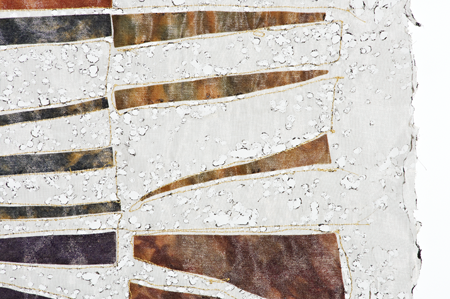
And in this piece the same shiny silver strips were bonded onto black organza.  It curled a bit, but that’s not necessarily a negative – it could be a lovely effect – and then a layer of black organza was added over the top.  Silver stitching outlines the shapes.  Something made with this kind of construction would meet the technical parameters of  ‘a quilt’.


One thing that has been on my mind is the very large cone of silver thread I’d had kicking around for a while, make that years, to be honest. Psychologically I am drawn to gold first, then other glitter.  I also really hope my expression of interest in the SAQA 25th anniversary exhibition, theme silver, will be successful!  but even if it isn’t – this silver was irresistible, and I am working on ways to include it in some of my works.  Next time I’m up in the US, I’ll look around for a gold equivalent.


Jack of All Trades, Master of None

June 25th, 2013

Well that’s the old fashioned phrase that came to mind when my new textile friend, Suzie Hammond, explained this lovely looking piece of furniture in her Santiago de Chile home last week.  She found it in a part of Santiago where interesting antiques abound, and restored the timber finish and replaced the upholstery.  As her husband Carl is a musician – piano and other signs of that are everywhere – I just assumed it was a piano stool with storage – the back was almost lost in some plants so that didn’t register too strongly to make me question my impression.

ironing board storage chair

Suzie told me, it certainly is a chair but not especially comfortable to sit in; and the seat does raise up to store something but only some papers or some sizes of sheet music; and the flip over back is actually an ironing table – that technically works but it does slope a bit and isn’t very good to use, either !   Goodness, I wonder who thought up that combination !! and what on earth do you call it – an ironing board with storage seat? or a seat with storage and attached ironing board? 

June 16th, 2013


One of my favourite columnists in our national daily, “The Australian”, is demographer Bernard Salt.   Many of his articles are based on observations and analysis of Australian census data, and you can tell which section of the recent census he’s been analysing.  Other articles are on his interesting observations of collective human behavior and social trends in modern Australia; and a recent article on styles of restaurant menus revealing social aspirations of its patrons was particularly pointed. (sorry, the whole article’s only available to subscribers)  Although published last month, somehow I missed it and only read it this morning,  and that happened to follow my first experience with a restaurant menu on a digital tablet thingy.  My trendier readers prolly smile that I am so far behind the times that this use of technology was new to me.

Bernard’s article made me think of a family member who message texts enthusiastically and frequently, but the only word she ever abbreviates is ‘you’ – and yes, it’s always to ‘u’ !!!  I can hear her voice in my mind whenever I read something from her, so even in a text ‘u’ always sounds like and awkward stop in the flow of what she’s saying – face to face she just talks normally, and that’s an interesting effect.

Writing one of my occasional fan emails to Bernard, I said:   “I want to mention another menu phenomenon a group of us came across only just last night, here in Montevideo, Uruguay.  After being seated at a restaurant, we were each handed a small iPad – a tablet I guess, I’m a bit behind in the technology department, a late adopter you might say.  Anyway the whole menu was on it!  Bernard, you’d have loved it – pretension taken to a slightly more sophisticated level.  You could select whatever language you wanted – and as Australians and Brasilians were present, and all speak at least some Spanish, we agreet to have the waiter give the nightly specials in that.

My menu experiences to date had been confined to the infinite variations on the written of printed format, (w/wo plastic sleeves and binders, including blackboards and the verbally delivered take it/leave it limited choice in some places.  As a late adopter, I had to be shown how to select a menu section of an item from a group, click twice and then scroll from side to side, but I got the hand of it easily enough.   Each menu item was photographed in colour with descriptions in Spanish and the chosen alternative language.  I noticed the photos really matched up very well with what we each received on our plates.  Great use of technology.   One thing I did find a little unsettling was that you couldn’t run your eye down the whole menu and get a feel for the total offering that night; there was no little ‘tonight’s specials’ slip tucked somewhere to let us know that the chef found particular foods either great quality or great value at the markets..

Now we had been there before, but over a year or more ago.  We’d liked the interesting cuisine with European and Asian influences, lots of herbs and spices, and creative presentation plus good value.  It’s still like that.  The owner/chef’s a creative man indeed – a Uruguayan returned home, bringing  influences from his world travels with him.  It’s a nice alternative to the most common menu here of parilla, the marvelous bbq-d meat found everywhere in this part of the world.  The national palette is very bland, so although the food is tender and  wholesome, it’s never spicy, hot or creatively assembled on the plate.  I think it’s the culinary and historical equivalent to dining out when I was a young thing – we were usually offered soup of the day, roast of the day, followed by jelly and icecream of tinned fruit salad and cream. (it was Tasmania in the mid ’60’s, after all)

In addition to the actual offerings, the e-menus conformed that this particular restaurant is indeed in an upscale neighbourhood, patronized by people with aspirations or who already have their point up on the  board.  It’s not our local neighbourhood, but I wouldn’t ben surprised to find at least one of our local eateries going that way, and must ask the trendies in my circle who are up with the latest and still eat out a great deal. As the cost of dining out here rises as it does everywhere else, we’re more often choosing to eat in than dine out.

Free Soup - Hot Pot Of Green Pea,carrots And Pumpkin Stock Photo - 6304140  A really delicious little cup of soup was a starter we all had – pumpkin with onion prolly, definitely banana, ground fresh ginger, and, um, not sure what else  – I have no recipe to pass on, just a nice idea, but I’m sure you can google something like it and experiment with the flavours.  We’re having version #1 for dinner this evening 🙂

Clever or Art?

June 10th, 2013

A pet peeve rant coming up today !

The Aunts' Quilt-001

M & J’s Quilt, 1999.


There is far more to any kind of art than expertise in a technique and the use of particular materials.  Very few gifted individuals have a natural sense of good design and colour usage.  The rest of us need to put in time and effort making our compositions work, perhaps studying along the way from people who can teach us more about the theoretical aspects of design.

Frequently, a quiltmaker discovers or learns a new technique, well new to that person, anyway, and, because it differs markedly from the more traditional ways of making quilted textiles they’ve been using up to this time, they get carried away with how they’re now ‘making art quilts’.  Then, since the internet does allow some of us to be very clever, the instant expert will often choose to go online with photographs or a short video tutorial on this marvellous technique they’ve recently discovered. Traditionally, quiltmakers have shared knowledge, advice and tips generously, but when a tutorial purports to teach how easy it is to ‘make an art quilt’ I feel a bit sad for someone who will view it, and then think they, too, can so easily be making an ‘art quilt’ just like it without spending time on matters of design and colour theory.

Dropping a few modern art names into a blog post about one’s latest completed project doesn’t elevate the quality of the art, either, and one of my very pet peeves is those who title their works to include well known names, and/or sprinkle their artist statements with references of influences by popular favourites such as Klimt, Mondrian, Picasso, Rothko, Matisse et al – in sort of self-glorifying critique mode, and this kind of thing is not confined to quilt makers, either.

The Gees Bend Quilters are very often referenced by modern quiltmakers once they adopt the improvisational style of piecing that characterises these and other historic Afro American textiles and similar textiles from other countries; and what people often mean by it is that they’re now using improvisational cutting and piecing styles instead of putting together precise geometric patterns.  I’m totally in love with this very free way of working, and have been piecing improvisationally/freehand/template-free since the early ’90’s,  but I would never dream of describing my work as anything  ‘like Gees Bend quilts’.

It bothers me every time I come across it.


Museum of Old and New Art – MONA, Tasmania.

June 9th, 2013

While visiting family and several friends in Tasmania recently, we made a point of going to the relatively new art museum there, MONA, Museum of Modern and New Art, at Glenorchy just north of Hobart.  I’d heard a lot about it, many people love it, and many say they don’t care for it.   I think some of those opinions are tinged by knowledge that the wealthy art patron David Walsh, who established and finances it, made his rather large pile through various highly successful gambling activities.  Tasmania is so very conservative about money.  ‘Old Money’ people don’t talk about their wealth at all, and tend to look down on ‘New Money” people, who do talk about it quite openly.  My mother was from Sydney, NSW, where they constantly and freely talk about the cost of everything, especially property and business developments.   She married into a Launceston family, who certainly knew their place on the financial ladder there – and when she talked of someone in the community, typically there was often a little qualifying comment, something like  “Of course, he could buy and sell half of Launceston…” or ,”They made a lot of money in …”  I have no idea whether she was ever right, close to right, or just tossing in such comments from habit and unfounded assumptions!  But, since one of her own aunts made a packet in Sydney industrial real estate in the ’30’s and ’40’s, and despite being a keen gambler at the dog track, she  managed and kept her fortune together well all her life, I think Mum would have been thrilled at David Walsh’s moves.  She might not have cared for some of the sexually explicit and other provocative exhibits, but it was Walsh’s intention all along to shock and challenge through art – he must be a curator’s dream patron, since nothing seems to be taboo, from what I saw, and indeed there is a focus on things that other institutions might have difficulty in justifying exhibition of them.   People are visiting in droves, and certainly talking about it.  Tourists and locals alike are also attending and talking about all the ancilliary events at MONA, too, including orchestral  concerts and wine and food events.  Tasmanian residents have free entry.  I liked that –  as although born and bred Tasmanian, I’m not living there just now and so didn’t didn’t qualify, of course.

So it’s been controversial to say the least – and not just in Tasmania.  It has had no trouble attracting publicity and reviews, and there is a lot about it online.  Here are a couple of  comments I found in the Wiki, representing quite different points of view:  First – Michael Connor of the conservative literary and cultural magazine Quadrant said that “MONA is the art of the exhausted, of a decaying civilisation. Display lights and taste and stunning effects illuminate moral bankruptcy. What is highlighted melds perfectly with contemporary high fashion, design, architecture, cinema. It is expensive and tense decay.”[10]      Then – Richard Dorment, art critic for the UK newspaper The Daily Telegraph, said that Walsh “doesn’t collect famous names; his indifference to fashion is one of the strengths of the coollection. He likes art that is fun and grabs your attention, that packs a sting in the tail or a punch in the solar plexus.”[11]       And, they could both be right.

In another article published in the UK’s Telegraph this very weekend,  a long article profiles the man David Walsh, his eccentric and perhaps elusive character, his life and the development of the museum from concept to reality, and what the world is making of it… there are mixed opinions, and this is a long but comprehensive article, but very worthwhile reading, particularly if you’re planning to go there.  Quite fascinating.   When we visited, I’d heard far less than I now think I know, and I thought it was fabulous, Mike not so much so -and that may be putting it kindly.  I’m still fascinated.

It’s a strange rather forbidding building exterior that reminded me a little of those huge monasteries perched on precipitous mountain sides in Tibet. The first pic is the one used in the recent ‘Telegraph’ article really illustrates what I mean – and perhaps it was taken on a cold dreary day just like the day we visited –

MONA forbidding exterior


And this next photo, in a kinder light, is courtesy Australian architect Lindsay Johnston:

MONA exterior   LINDSAY JOHNSTON


This building complex, however, is not perched on a mountainside but sits on a slightly elevated site above the River Derwent, lodged in a hollowed-out sandstone hill (we wondered how they got planning permission for that in a green state like Tasmania? ) 

MONA massive sandstone walls

You go in at the top and descend to the bottom where you pick up your ‘O’ – an adapted iTouch device, and then self paced you wander through exhibits of old and new art.  Your path through the several floors of galleries regularly brings you face to face with massive limestone walls rising from the bottom to the top floor.   In the pic above are people watching a water display that shoots out droplets to form words of the day’s headlines and popular search engine words.   it was rather mesmerizing.  The walls are awesome in their rockbolted state for stability, although the geologist in our party was not sure they had been correctly bolted, according to his underground experience.  Water was entering and running down the walls in places, and it definitely felt like being in a mine.

MONA massive sandstone walls 2

Your ‘O’ senses where you are in the museum and what works are around you – and on it each of the near works is pictured, and when you touch the pic it takes you to basic information, perhaps some review or critique ( called ‘wanks’) although not every work has a wank app – and you can vote on whether you love it or loathe it – no in between opinions – you like it or you don’t …  and I loved that decisive approach, although found it hard once or twice and then just refrained from giving my opinion.  It tells you then how other museum visitors have rated that work.  That was fun, to me, to know how my voting compared.  Of course, it really doesn’t matter, does it, as love it or loathe it is a personal choice only, and in the end, who cares?   There is often humour, and often ugliness, there is lots of old and new beauty run through with themes of sex and death predominating.  Many exhibits are definitely confronting – you can read about them elsewhere, written about by people far more erudite in art matters than myself… I just happily made my way among them, loving or hating as I went.   After about 3 hours I was mentally exhausted and although I would like to see more, we didn’t have time to go back on this visit.  It will keep, as long as water levels don’t rise more than a metre or two. 

I was thrilled to be able to see Sidney Nolan’s “Snake” in its entirety:

Sidney Nolan Snake    Lindsay Johnston Photo Lindsay Johnston

You just can’t get any idea of its overwhelming power from the pages of a book or tv doco.  It’s never been previously hung it its entirety in Australia, and I learned just now that Walsh’s apartment windows afford him a commanding view of the total installation.  Well its the least he could have in return for the massive debts and running expenses for the museum!  I’ll go back sometime, and look forward to that.


Entries (RSS) and Comments (RSS).

All images and text are © Alison Schwabe
Reproduction of any kind is expressly prohibited without written consent.

Translate »