Archive for the ‘General’ Category

The Glorious Straight Stitch

Sunday, September 15th, 2013

Sunburnt Textures Emb

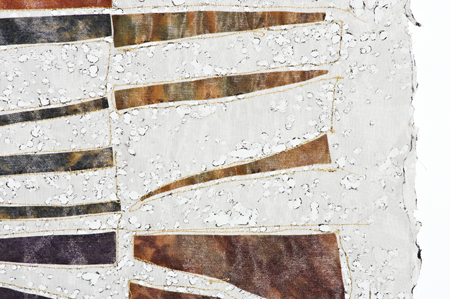
Shown above is the title piece from my 1987 solo exhibition, ” Sunburnt Textures”,  and the detail is below.  Long before I started making quilts in 1989 I was using my favourite stitch, straight stitch in various forms in my fabric and thread art.  Other favourites include stemmed French knots, and stemmed Y-stitch.

Autosave-File vom d-lab2/3 der AgfaPhoto GmbH

Other examples are in the first gallery on my website, The Creative Stitch; pre-1988


Of course it is the running stitch that usually forms quilted textures but many other stitches can be used in lines or scattered/single form to function as quilting, although few contemporary quilt makers thoroughly explore these options.    I am currently doing some more explorations with the straight stitch:

straight stitch samples 1

I did have hope that this construction of the silver mylar between a metallic fabric and sheer nylon would somehow lie flatter with added stitchery – sadly it won’t, but that aside, there’s some exciting stuff stored in this little sample.  If I layered it with backing and batting it probably would then be flat, but I don’t want to do that so will have to  try something more, which might take a while to come to me.

Unusually for me, right now I have a piece in mind that already has a title, more or less, something like “Mostly about Red”  I am planning to use more of that shiny black chintz as the base,  bond mostly red shapes onto it, and straight stitching over the shapes like this.  I have some lovely florescent/neon threads that will really sing – like green which is of course opposite red on the colour wheel:

Sample - straight stitch over flat shapes


auditioning for red

Finally,  the red scraps and several uncut pieces  of red that made it through the auditioning process for the ‘red’ work.

From every pieced project, which I cut and sew freehand, ie template free, I save the offcuts  and segments of pieced fabrics in the large clear plastic bag you see on the chair behind the table.  The way I work, using many small pieces, I can often find great small pieces in the bag and use them – not because I’m miserly, there’s only a small amount of Scots blood in my veins – but it just makes sense to check out what I have in small bits first before cutting into the larger pieces, and there’s the thrill of a treasure hunt going through that digging deep process.


Surveys Point To Change

Friday, September 13th, 2013

Alison Schwabe small blog

I just love a good survey – and I’m always happy to give my opinion on something that interests me.  I suppose you could say that the greatest of all surveys is a national election that either brings a change in government or avoids it.   In just the last couple of weeks,  I responded to interesting surveys in the general area of textile and fibre art education, principally art quilting.  

(1)   Lisa Call  asked around fellow SAQA members to see if any one knew of classes on basic techniques of what you can do with fabric for aspiring art quilters, saying she was looking for “an overview/survey type course for art quilts…. a variety surface design techniques … collage, and a bit of piecing …”  ending with asking for suggestions on how one might learn such things, and clearly favouring online learning.  I felt she was looking not for someone to teach ‘it all’ for I think the field is too vast to wrap one’s mind around.  Her student will need guidance, help in recognizing what technique has been used in a particular work she likes, and then finding a good online location to learn the basics of that technique, after which its all up to her to run with it, or not.

(2) Fellow SAQA member Roxanne Lessa asked us and her blog readers to let her know what they would like to learn from her, citing an extensive list of  things she’s be interested in teaching or tutoring on.   I’m not looking for a course or a mentor just now, so just moved on.  From this list, though, you need to have some idea of what you wanted to learn before you even contacted her, perhaps how she did something in one of her works pictured on her website.

(3)  Teacher and art quilt maker Dena Crain recently surveyed quilt artists seeing their comments on how art quilters rank the value of learning the same course material through  (1) attending workshops/courses taught in real time   (2)  classes taken online  (3)  learning through a lesson in a book or periodical  (4)  ditto via a digital or eBook format.  Of course, the costs of accessing each one could never be exactly equal, but for the survey we were asked to assume they were, and rank our choices with any comments/reasons for them.  She summarized her findings in today’s very interesting blog post The Future of Education for Patchwork Quilters  She is an American living in Kenya – and in her remote location faces varying kinds of location from what US, UK, European, many Australian, New Zealand, Japanese and other Asian quilt makers take for granted – relatively easy access to real time classes, easy access to vendors of supplies or mail order that works beautifully, and so on.  Knowing a lot about Dena and her geographic perspective, and seeing similarities to my own situation, of course I had views on this and did not hesitate to respond !

While I’m certain workshops and classes that you physically attend will always will always rank high for learning because of the huge potential offered by real face time between all students and teacher involved, technology is changing fast to make recorded and live online demonstrations, classes, courses, seminars,  etc.  all feasible and highly worthwhile, with different advantages to suit the individual.  The offerings in fabric and thread alone are massive, and include some extremely good on almost every technique you can think of,  but also plenty of mediocre ones; with costs ranging from free to rather expensive.   How fortunate are today’s craftsmen and artists to be able to choose to learn wherever we look from the comfort of our own homes.  And on that note, even though I don’t plan to leave the house on this rather wet day, it’s time I showered and dressed before spending time in the studio.   I’ve been doing some samples and am keen to start pursuing a couple on a larger scale – but to get started there, “I like to be clean and tasteful” as my fav. Aus satirist comedian Barry Humphries, speaking as Dame Edna Everage,  would say  🙂


Quilt Auction Begins Today!

Monday, September 9th, 2013

The annual Studio Art Quilt Associates’ Benefit Auction for 2013  kicks off in a few hours’ time, at 2-00pm, Eastern USA, currently 12 hours ahead of Australian EST    Over the next three weeks, and at the International Quilt Festival Houston in late October, the 420+  12″/20cm square quilts made and donated by Studio Art Quilt Associates  members from many countries around the world will be auctioned to raise funds to help cover SAQA’s art quilt touring exhibition programme.

Later today bidding will open on the first group of pages 1a and 1b.  They include several I would love to own, and include something for every taste.  “Sandlines”  below, goes up for sale today and I have my fingers X it might sell in the first part of the week.  On august 5th I wrote a bit about it, and my workroom/studio, in The SAQA-Oceania Bloghop

Sandlines - small


All pieces on those two pages will be $750 starting today, Monday, Sept. 9th at 2.00 pm Eastern until 1-59 pm Eastern on Tuesday, Sept. 10th, at which time unsold quilts on that page will be re-priced to $550, the price going down each day until the end of the week.    Group b auction begins 2-00pm Eastern next Monday sept.16th.  At http://www.saqa.com/saqa-u.php?ID=2367   you can find more information about how the auction works, the online bidding form (not live until 2-00pm US  Eastern later today), pages with images of all 421 pieces by this year’s contributing artists, and if you click through those images you can access technical details of their work, and click through their names to go to their websites if they have one.


Life’s Rich Tapestry – The Emergence Of a Core Theme

Friday, September 6th, 2013

EDITED UPDATE of original post September 6th, 2013.

In 2013 this quilt:“Life’s Rich Tapestry”, went up onto Lisa Call‘s FB page, in a discussion we were having about how embellishment was in each of our distant textile art pasts.  She posted a very red and strong green quilt with lots of bead and glitter embellishment, a piece that seemingly has no connection to the plain uncluttered textile paintings she now does with austere lines, plain colour combinations and heavy machine quilting.  We had both studied in classes with David Walker. My textile art roots go back to creative embroidery in the late 70’s until in the late 80s I ecountered patchwork and quilting. That soon morphed into the fairly new genre of ‘art quilting’ and I attended the first Quilt Surface Design Symposium in 1991. Lisa’s embellishment / embroidery experience with a David Walker class was a little later.  

In that 1991 symposium workshop, David had us thinking about our own lives, sifting through events and exploring developments. An occasional saying of my husband Mike’s came to mind: ‘That’s just part of life’s rich tapestry’.  I have no idea whether the title came first or it developed from the ideas I was exploring, but no matter. The elements of the design relate to the good and bad, darks and lights, positives and negatives, happy and sad, lean and plenty – the ‘things’ in life that constantly shift balance and change from day to day, week to week, year to year, one factor of which was the various relocations we’ve had on account of his profession. There’s a bit of management and a bit of luck in that mix, too.  

Life's Rich Tapestry 2
Life’s Rich Tapestry 2 1990 190cm x 190cm

In that memorable class we all developed some imagery to use in our original art quilt designs. 

Because Bernina made the fabulous new 1230 machines available for symposium participants to use, I decided that I might as well use it as a test drive opportunity, and put it through most of its paces. I tried out all the fancy embroidery stitches in gold thread to cover all the seams of this contemporary crazy patchwork background. It took miles of thread, but the effect was great, and the embroidery functioned as the quilting.  By the end of that workshop I was absolutely hooked on that machine, and on my return to Denver bought a demo-model from a dealer there.  This is actually the second version of my design, and went to Visions early the following year. I didn’t publish it on my website until that 2013 post, as I always saw it as totally different in every way from work I have done before or since.  So, what’s the scoop on this one? 

The big snake figure is the Rainbow Serpent, the most important spirit to the indigenous Australian Aboriginal people. It oversees and controls all aspects of Life, and dominates the quilt’s design. Fortune/Luck is symbolized by the dice and the chequered game board that a number of tble games require. In the game of Snakes and Ladders(c) each player throws the dice and moves forward, moving even faster by ascending a ladder if he arrives at the foot of it. If the throw of the dice means that the player’s turn finishes on the snake’s head, that’s bad luck and he’s penalised by sliding down to the end of the snake’s tail – ie progresses backwards. The winner is the first player to reach the end of the 100 square course. Life is a mixture of the action of forces we don’t see or undrrstand, and sheer luck coupled with the ability of make the best use of opportunity when it appears in our lives.

Thanks to Lisa’s 2013 FB post,I realised that this work, “Life’s Rich Tapestry” marks the beginning of a recurrent theme in my quiltmaking that by then had prompted the “Ebb & Flow” quilts and all the “Tracks” quilts of the 2000s and 2010s. I began to see that both series of quilts were really connected, in different ways, to what had seemed an odd outlier, an abberant quilt design when I made it back in 1990. Just at that time I was entering a phase of using 1/2″ strip inserts, a technique which became a signature in my designs of the late 1990s and early 2000s, like Ora Banda, but I still hadn’t fully realised that a technique alone is not ‘art’.

Ora Banda, 1992 120 x 150cm Quilt National 1993.

Those strip inserts over time became much more curvy and eventually quite variable in width, and the phase lasted a long time really, up to around 2015. Eventually I began to focus less on the technical skill I’d developed and think more deeply about the meaning of my art. So, in the longer perspective, “Life’s Rich Tapestry” is important in understanding the role of remembered experience in my own artistic vision.

Glimpses Into The World of Pet Bird Owners

Friday, September 6th, 2013

Today’s post is an exception to the ‘no fluffy pets’ parameter on my blog.  Well, technically birds aren’t fluffy, are they?  Once they’re through the fledgling stage they’re ‘feathery’.  So its OK just this once.  I could always claim I am inspired to design a quilt  on the theme of birds… now that’s an idea perhaps.  But, anyway I do have just a little experience with pet birds – as a kid I had several budgies in a cage, and later I worked in an office where I was a co-owner of a lovely male canary we named Mario (Lanza) for the quality of his voice; and our nextdoor neighbours here have a medium sized parrot which is often out in the garden; his wings are clipped and he can climb around.  He can’t see us, but plays Marco Polo with us over the fence, and babbles a running commentary on things, in Spanish of course, often demanding the attention of “Abuela!”  (Grandmother)  I didn’t see Daniel and Maria  move in, so for the first couple of days this racket over the fence had me wondering about the noisy naughty child that was being made to stay outside all day it seemed – I had begun to think ‘child abuse’ …but all is well at #2043.   Over here we balance things up with our loudly vigilant dog, and no one complains.  Parrots often live 60+ years and they’re often mentioned in wills.


When you move to another part of the world, most countries will happily accept you and your children without any quarantine as long as your shots are up to date, etc.  But animals of all kinds, not just dogs and cats, are a different matter.   I recently met a new arrival to Montevideo and he opened my eyes to the difficulties of relocating internationally with a bird.  I have friends who have had cats, dogs and sheep coming and going, but until  I met new arrival here, Mick, I just had not thought about how strongly a bird owner might want to bring his pet along too.  Mick’s bird is a small parrot called a Wierro or Cockatiel.  Native to Australia, these little birds are cheeky, fun, curious and, because they learn to talk well too, they’re popular as family pets.   You can find many lovely images of them here , gorgeous.  Bobby is pictured below, but he just could not resist pecking and clawing the camera’s shiny bits and pieces, making it impossible for a good clear shot.  When I tried to sharpen the image he looked OK but then the arm/perch he was on and the background looked rather grainy – impossible! Hence, the link to the images which will show he’s a classic little specimen in every way.

Bela the Bird

Mick and Erica wanted to bring Bobby with them on assignment here for a few months, and contacted Australian and Uruguayan customs authorities, to learn what they had to do for this to happen.  Heaps of paperwork covered a mandatory month of supervised domestic quarantine both before and after travel, the cost of that plus vet and permit fees at every turn, and then doing all that in reverse a few months later.  Once they realized how costly and involved this would be, they dropped that approach and looked around for someone to board him with for the few months they’re here.  They discovered extensive networks out there for bird owners, on- and off-line, exactly like what’s around for dog and cat owners, and if truth be known, probably goldfish and gerbils, and other creatures great and small.  There are vets who specialize, there are search and rescue groups, there are adoption and humane groups, and, online, there are chat lists and discussion forums.   And boundless opportunities for networking while exhibiting your bird and competing with other owners.


Someone put them in touch with Kaylene, a dedicated bird lover and owner who’s become the temporary carer for Bobby.  She takes it very seriously, as the following message to Mick recently shows: “Bobby won’t eat any of the yellow fruity ‘Pretty Boy’  items, nor the one yellow thing in the cockatiel seed mix I bought. Should I just throw them out? Does he hate yellow? I tasted them–can’t see any difference in flavor or texture between the little red, orange, green balls, and the crescent shaped yellow items?  Bobby isn’t really happy, misses you I’m sure. He squawks like crazy when I leave the room or talk on the phone, but doesn’t trust me enough to come out of the cage yet. Every evening around 5 he whistles and sings–very sweet. Does he have a problem with yellow foods?”     I laughed hearing this, but Mick had more gems, too.  Read on.


Kaylene herself has a new young little budgie, Sweetie, everyone knows these little cuties  they’re easy care, and lots of fun, but Kaylene is currently a bit concerned about Sweetie, as she posted on the chat board that Mike now follows:  “…he sleeps hanging upside down like a bat, the only time I’ve seen him asleep he’s hanging upside down. Is this normal? He seems fine when he wakes up.”  And sure enough once she posted this, someone was there with helpful advice: “Budgerigars like to sleep high in their cages. You might try putting a small sleeping perch or shelf/roost close to the top of his cage to see if he prefers it.   I prefer shelves for sleeping and I prefer them to be fairly small and one-per-bird so if you have multiple birds they won’t fuss and fidget for position on the same perch. Obviously if you currently just have one budgerigar alone in a cage that is not as much of a concern but IMO you should still build out his cage as if he is going to have a roommate someday, because he probably should.”   What a hoot – this budgie expert fancies the birds will be better sleeping on shelves for heavens’ sakes!!  and has obviously never seen them in the wild or even a small flock in a large zoo or bird park – because they DO jostle on perches and branches, constantly, with a whole lot of soft chattering going on.  It’s probably the pecking order thing that needs every bird to get in their right position before the group can calm down.  Shelves indeed.  I could add here I had budgies once and they loved the little swings we had in the cage.  Trees blowing in the wind kind of motion?


Then the new budgie owner wondered: “Should I mist him? Is bathing critical ?”  and a more experienced owner responded : “Definitely – I mist my birds with warm water and they love it! You can mist them daily or a few times a week – it helps keep their skin and feathers healthy. When you mist Sweetie, just mist in the air above his head; not directly at him. See how he likes it that way first, so it isn’t so traumatic.”

And the response demonstrates Kaylene’s anxiety for all this care and responsibility: “I have a mister, must try it out soon. I’m sure he will run away from it, so I’ll only mist him a little bit at first.”  Like any other new carer of a little young life, she must have been somewhat calmed by this advice: “Regarding mist baths, spray into the air and let it waft down on him to  get him used to it. Be persistent and give him time. If he is scared of the mist bottle, let him slowly get used to seeing it from across the room, then successively closer to his cage until he is comfortable around it.”  Shades of Dr. Spock or a modern parenting magazine,  LOL.


The chat forum produced this one, too:  “Kiki, my parakeet has taken up drumming, rat-a-tat on a cardboard box. Almost every day. Are little drums for parakeets available? ”    Someone responded:  “LOL 🙂  she needs a friend to sing to her drumming 🙂  ” 


But, back to the bird importing process Mick and Erica had started but then just let lapse.  Within a couple of days of their arrival in Montevideo, they were visited by very worried customs officials demanding to immediately inspect (and possibly impound) Bobby the cockatiel – and they took some convincing that after all the bird did not come with them.  Of course, Mick and Erica hadn’t notified customs this import wasn’t going to happen after all – why would you?  I guess the customs people believed the bird had been smuggled in to get round the paperwork and costs.   Clearly, once a bit of paper is in the system here, it’s on the record and difficult to remove.   But I’m not going to inflict bureaucracy stories on you in this post –  like the 9 hours it took to get a duplicate driver’s licence, or the incredible difficulty we had changing something on our fixed line phone account because someone hadn’t entered my husband’s ID# on the account years before, leaving the original subscriber’s ID# in place.  That man died several years before we came along, and despite that we’d been paying the monthly statement that always came addressed to us, in the end it needed a paralegal with good table thumping ability to sort that one out.


Entries (RSS) and Comments (RSS).

All images and text are © Alison Schwabe
Reproduction of any kind is expressly prohibited without written consent.

Translate »